
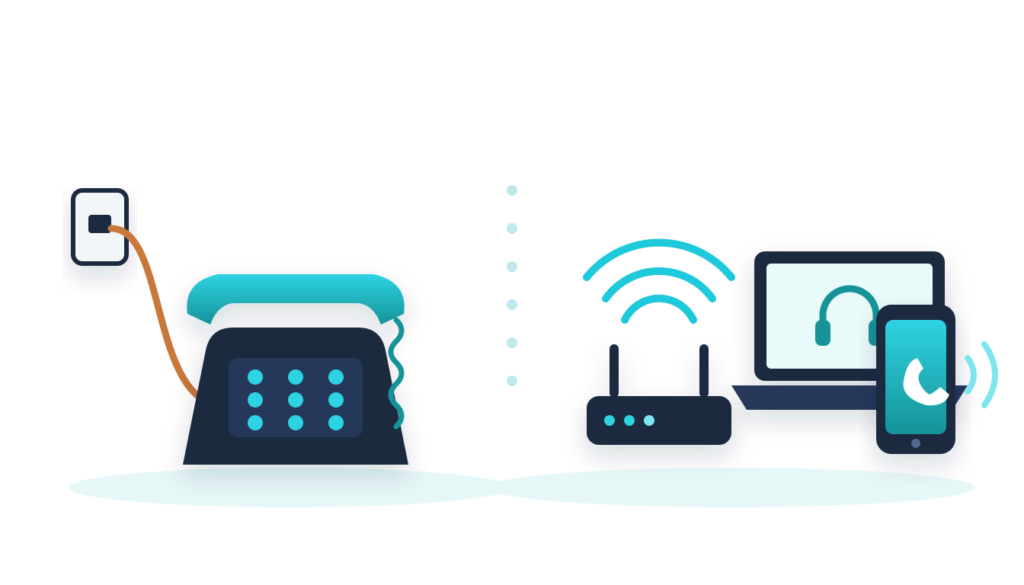
VoIP vs landline used to be a real debate. In 2026 it’s mostly a question of when you switch, not if. The old copper phone network is being wound down across the US, and phone companies are pushing customers onto internet-based service whether they asked for it or not.
But “VoIP is better” is not the whole answer. Landlines still win in a couple of specific situations, and VoIP has real downsides you need to plan around, especially for 911 and power outages. So let’s do this properly.
Some context on where I’m coming from. I’ve been selling online since 2005 and running high-ticket stores since October 2010. Phone sales were a big chunk of revenue on those stores, because people spending thousands of dollars want to talk to a real person before they buy. I went on to start Ecommerce Paradise in 2015 and I’ve lived in Bali since about 2019. My US business number runs entirely over the internet. A landline would be useless to me here. That said, I’ll give you the honest picture for your situation, not mine.
The provider details below are research-based, checked on official pricing pages and government sources as of November 2026, following our editorial standards.
The quick answer
For most small businesses, VoIP wins on cost, features and flexibility. Keep a landline or a dedicated backup only if you have devices that need one, like some alarm panels, elevator phones or fax machines, or if you’re in an area with unreliable internet.
| Factor | VoIP | Landline |
|---|---|---|
| How it connects | Over your internet connection | Over copper phone lines |
| Monthly cost | Usually lower, from about $15 per user | Usually higher per line, varies by carrier |
| Features | Apps, texting, auto attendant, voicemail transcription, AI answering | Basic calling, voicemail, some add-ons |
| Mobility | Answer on any device anywhere | Tied to one physical location |
| Works in a power outage | Only with backup power for your internet gear | Traditional copper lines often carry their own power |
| 911 location | Sent from the address you register | Tied to the fixed line address |
| Setup | Minutes to days | Technician visit |
| Future | Growing | Being phased out by carriers |
What is a landline?
A traditional landline is a phone line delivered over copper wire from the phone company’s central office to your building. Industry folks call it POTS, short for plain old telephone service. The phone company runs the switching equipment, so your call travels on a dedicated circuit the whole time.
Here’s the catch. A lot of what phone companies sell as a “landline” today is already digital behind the scenes. If your phone service comes from your cable or fiber company, it’s very likely VoIP already, just with a phone jack on a box in your closet.
What is VoIP?
VoIP stands for Voice over Internet Protocol. Your voice gets turned into data packets and sent over the internet, then turned back into sound on the other end. You can use desk phones, a computer app or a mobile app.
For a business, VoIP almost always comes as a hosted phone system with your numbers, extensions, menus and apps in one monthly bill. My guide on what VoIP is and how it works goes deeper. My guide on hosted PBX phone systems covers the business system side.
Why landlines are disappearing
This is the part most people don’t realize. Big phone companies have been retiring copper networks for years because they’re expensive to maintain and most customers have moved on. The FCC has been pushing the same direction. In 2025 it proposed rules to cut barriers for carriers making network changes and to speed the shift to all-IP networks, while protecting access to 911. You can read the FCC’s 2025 proposal in the Federal Register.
What that means for you is simple. Copper service is getting harder to buy, harder to get repaired and, in many places, more expensive. If your business still relies on copper lines, plan your move now instead of waiting for a discontinuance notice from your carrier.
VoIP vs landline: cost
Let’s talk money, because that’s usually what decides it.
VoIP pricing in 2026
Here’s what popular business VoIP providers list on their official pricing pages as of November 3, 2026, before taxes and fees.
| Provider | Starting price | Notes |
|---|---|---|
| Quo | $15 per user per month | Billed annually. $19 month to month |
| Nextiva | $15 per user per month | NEXT Core on a 12-month term. $23 monthly |
| Talkroute | $19 per month | Basic plan with 1 user, $5 per additional user |
| RingCentral | $20 per user per month | Core paid annually. $30 paid monthly |
Most of these include unlimited calling to the US and Canada. Quo, for example, says calling US and Canadian numbers is included from any country with an internet connection, subject to its fair use policy. That’s exactly how I call US customers from Bali without extra charges.
Landline pricing
Landline pricing is all over the place. It depends on your carrier, your state, how many lines you have and what bundle you’re on. Long distance, voicemail, caller ID and hunt groups are often extras. And as carriers retire copper, prices on the lines that remain tend to drift up.
The best way to compare is to grab your last phone bill. Add up the total, including taxes and fees, and divide by the number of lines. Then compare that number against a VoIP plan with the same number of users. For most small businesses I talk to, VoIP comes out cheaper, often by a lot.
Hidden costs on both sides
- VoIP: taxes and regulatory fees, texting registration (10DLC) fees, desk phones if you want them, and better internet if yours is weak.
- Landline: per-line fees, long distance charges, add-on features, installation visits and repair delays.
VoIP vs landline: call quality and reliability
Call quality
A landline on a healthy copper line sounds clear and consistent. VoIP can sound just as good or better with HD audio, but only if your internet is solid. The problems with VoIP quality usually come from three things: not enough upload speed, high jitter or a router that doesn’t prioritize voice traffic.
If your office has decent business internet and you set up QoS on your router, you’ll be fine. Each call only needs about 100 kbps in each direction.
Reliability
Copper landlines have a long track record of staying up. VoIP depends on your internet connection and your power. If either goes down at your office, your desk phones go down too.
But here’s the flip side. With VoIP, the phone system itself runs in the cloud. If your office goes offline, calls can automatically ring your cell phone app instead. A landline can’t follow you anywhere. When a storm takes out the line at your shop, the calls just ring into nothing.
911 and power outages: the most important section
Do not skip this. This is where the VoIP vs landline choice actually matters for safety.
Power outages
Traditional copper landlines often carry their own power from the phone company, so a basic corded phone can keep working during a blackout. VoIP needs your modem, router and phones to have power. In an outage, no backup battery means no calls.
The fix: put your modem, router and any network switch that powers your phones on a UPS battery backup. And make sure people have a charged cell phone.
911 location
With a landline, 911 dispatchers get the address tied to that physical line. With VoIP, the provider sends the address you registered. If you move or take the phone somewhere else and don’t update it, emergency services could be sent to the wrong place.
Federal rules require interconnected VoIP providers to tell every subscriber, plainly, when 911 might not work or might be limited. That includes moving your equipment, an internet outage and loss of power. You can read that requirement in 47 CFR Part 9, the FCC’s 911 rules. Providers must also deliver 911 calls with a dispatchable location, like your street address plus suite or floor.
If you run a multi-line business phone system, Kari’s Law also requires direct 911 dialing with no prefix like 9, plus a notification to someone on site. The FCC’s 2019 order on Kari’s Law and RAY BAUM’S Act explains it.
What to do:
- Register the correct emergency address for every phone and user in your VoIP dashboard.
- Update it whenever someone moves or works from a new location.
- Put your network gear on a UPS battery backup.
- Keep a cell phone available as a backup way to call 911.
- Confirm exactly how 911 works with your provider for your location.
VoIP vs landline: security and spam
Landlines are hard to hack remotely, but they can still be tapped physically and they get just as much robocall spam as anyone. VoIP brings a different set of risks you need to manage.
- Account takeover. Your phone system lives behind a login. Use strong passwords and turn on two-factor authentication for every admin.
- Toll fraud. If someone gets into your account, they can rack up international calls on your dime. Restrict international dialing to the countries you actually call and set spending alerts.
- Spam labels on your outbound calls. Carriers use caller ID authentication called STIR/SHAKEN to verify calls. Good VoIP providers sign your calls so they show up as legitimate instead of “Spam Likely.”
- Texting rules. If you text customers from a business number in the US, you need 10DLC registration through The Campaign Registry. Quo’s pricing page lists that registry fee at $1.50 to $3 per month depending on use case.
The upside of VoIP here is visibility. You get call logs, recordings where legal, and admin controls you never had with a copper line. You can see exactly who called, when and for how long. That’s huge when you’re trying to figure out why a sale didn’t close.
VoIP vs landline: features
This is where VoIP runs away with it. Here’s what you typically get with a business VoIP plan that a basic landline doesn’t give you:
- Mobile and desktop apps, so your business number rings on your cell and laptop.
- Auto attendant menus that route callers to the right person.
- Business texting from your main number.
- Voicemail to email with transcription.
- Call recording, where the law allows it. Some states require all parties to consent, so check the rules for you and your callers.
- Business hours routing, so after-hours calls go to voicemail, a cell phone or an answering service.
- CRM integrations that log calls automatically.
- AI answering. I use Quo’s AI agent, Sona, so calls still get answered when I’m asleep in Bali. My AI receptionist guide covers how that works.
For a high-ticket store, those features add up to more sales. A missed call is a missed order. VoIP makes it a lot harder to miss calls.
VoIP vs landline: mobility
A landline is stuck to a wall. VoIP goes where you go.
This is personal for me. I run my US business number from Bali. Customers dial the same US number they always have, and it rings on my phone over Wi-Fi. If someone needs me directly, I tell them to WhatsApp me. None of that is possible with a landline.
If you have remote staff, field techs or you travel a lot, mobility alone is reason enough to switch. And if you make calls overseas, check my guide on VoIP international calls.
When a landline still makes sense
I promised honesty, so here are the cases where I’d keep a landline or a dedicated backup:
- Alarm and fire panels, elevator phones and some medical alert devices that were built for analog lines. Talk to your alarm company before you cut anything. Many now offer cellular communicators.
- Fax machines that you can’t replace with online fax.
- Rural locations with poor or unreliable internet where copper is still well maintained.
- A single backup line for emergencies at a site where people can’t count on cell service.
For everything else, VoIP is the better tool.
How to switch from landline to VoIP
Here’s the simple process I’d follow.
- Audit your lines. List every number and what it’s used for, including alarm and fax lines.
- Test your internet. Run speed tests at busy times and check upload speed and jitter.
- Pick a provider and start a free trial with your actual team.
- Port your numbers. Keep the old service active until the port completes so you don’t lose the number.
- Set up your call flow, business hours and voicemail.
- Register E911 addresses for every user and phone.
- Put your network gear on battery backup.
- Cancel the old lines only after everything is confirmed working.
If you’re starting from scratch, my business VoIP for beginners guide walks through planning your call flow before you switch.
What I’d choose in 2026
Here’s my honest take by situation.
Solo owners and small teams
Quo (formerly OpenPhone) is what I use myself, because it’s dead simple, includes US and Canada calling and texting, and its AI agent can answer when you can’t. It lists from $15 per user per month billed annually, and there’s a 7-day free trial so you can test it on your real internet.
If you mainly want a business number on your cell phone without a full system, Grasshopper is a simple virtual phone system with plans starting at $14 per month on its pricing page.
Growing teams
Nextiva is worth a look if you want one platform for phones, messaging and customer service as you grow. NEXT Core lists at $15 per user per month on a 12-month term.
Budget-conscious small offices
Talkroute fits tiny teams, because its Basic plan bundles 1 user for $19 per month with $5 per extra user.
For a full ranked list, see my roundup of the best VoIP for small business.
FAQ
Is VoIP better than a landline?
For most businesses in 2026, yes. VoIP is usually cheaper, has far more features and works from anywhere. A landline can still be the better choice for alarm panels, fax machines, or locations with poor internet.
Does VoIP work when the power goes out?
Not on its own. Your modem, router and phones need power. Put them on a UPS battery backup, and set calls to forward to your cell phone app if the office goes offline.
Can I keep my landline number if I switch to VoIP?
Yes, in most cases. You can port your existing number to a VoIP provider. Keep the old service active until the port is finished so you don’t lose the number.
Does 911 work on VoIP?
Yes, but it depends on the address you register. VoIP providers send the registered address to dispatchers, so keep it up to date. Providers must warn you about situations where 911 may be limited, like power or internet outages.
Is VoIP cheaper than a landline?
Usually. Business VoIP plans start around $15 to $20 per user per month on major providers as of November 2026, often with unlimited US and Canada calling. Landline costs vary a lot by carrier, so compare against your actual bill.
Are landlines being phased out?
Copper landlines are being retired across much of the US as carriers move to fiber and IP networks, and the FCC has proposed rules to speed that transition. Check with your carrier about plans for your area.
Related guides
- What is VoIP?
- What is a hosted PBX?
- VoIP phone service explained
- Best VoIP for small business
- Business VoIP for beginners

Trevor Fenner publishes VoIP Paradise, covering business phone software, remote-team communications and practical calling workflows. Articles distinguish documented research from direct testing.