
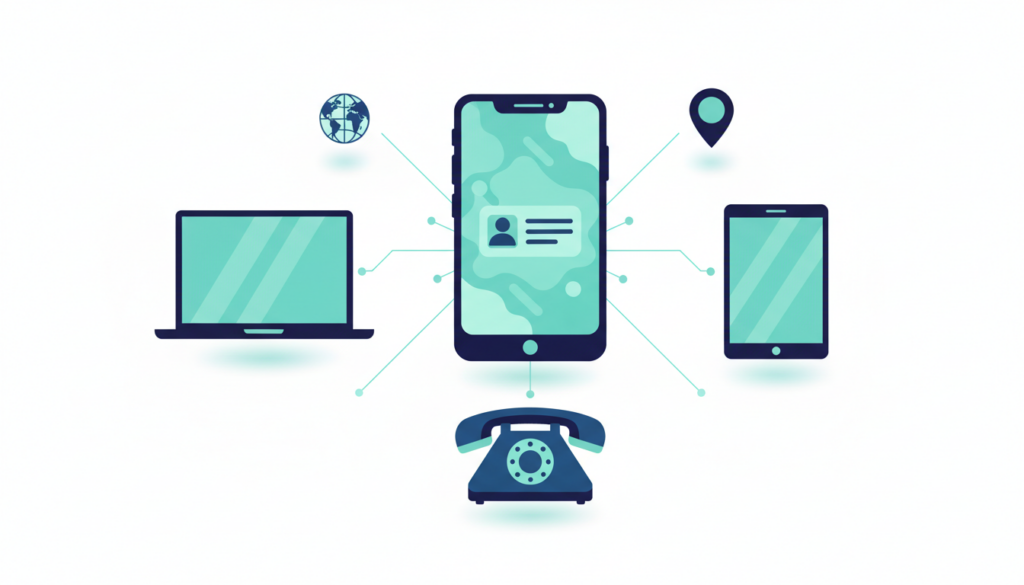
A VoIP number is a regular phone number that isn’t tied to a SIM card or a copper phone line. It lives with an internet phone provider, and it rings wherever you log in: your phone app, your laptop, a desk phone, or all three at once.
To the person calling you, it looks and works like any other number. They dial 10 digits and you pick up. The difference is all on your side.
I use one every day. I live in Bali, and my business runs on a US number through Quo. Customers in the States call a normal US number, it rings on my phone or laptop over the internet, and when I can’t answer, Quo’s AI agent picks up. If someone wants me directly, I tell them to WhatsApp me. No US SIM card. No landline. Just a VoIP number.
In this guide I’ll explain how VoIP numbers work, the different types, how they compare to mobile and landline numbers, the real downsides, and how to get one. Provider details below come from official pricing and support pages I checked on November 3, 2026. I use Quo personally. Other providers are covered from research, as our editorial standards require.
What is a VoIP number?
A VoIP number is a phone number assigned to you by a Voice over Internet Protocol provider instead of a traditional phone company or mobile carrier. Calls to that number travel over the internet to whatever device you’ve logged into. It’s sometimes called a virtual phone number, a cloud number or an internet phone number. They all mean roughly the same thing.
If you’re new to how the calls themselves work, my guide on what VoIP is covers the technology. For this article, the key idea is simple: the number is no longer glued to a piece of hardware.
Phone numbers themselves follow a global standard. The ITU’s E.164 numbering plan defines the format, a country code plus a national number, used by every phone number on the planet. A VoIP number fits that same format. That’s why anyone can call it from any phone.
How a VoIP number works
Here’s what happens when someone calls your VoIP number:
- The caller dials your number from any phone, mobile or landline.
- The phone network routes the call to your VoIP provider, because the provider controls that number.
- The provider checks your rules: business hours, who should ring, menus, voicemail, AI answering.
- The provider sends the call over the internet to your apps or desk phone, using a protocol called SIP to set up the call.
- You answer, and your voice travels back as data packets.
Outbound calls work the same way in reverse. You dial from the app, and the person you call sees your business number as the caller ID, not your personal cell.
That last part is a big deal. On my high-ticket stores, the phone number sat on every single page. That’s exactly the kind of place you want a business number, not your personal cell. Customers get a real business line. You keep your personal number private.
Types of VoIP numbers
Not all VoIP numbers are the same. Here are the main types you’ll run into.
Local numbers
A local number has an area code tied to a specific city or region, like 206 for Seattle or 415 for San Francisco. The trick with VoIP is that you don’t have to live there. Quo’s local numbers guide says you can pick numbers in most US and Canadian area codes regardless of where you’re physically located. I run a US number from Indonesia, so I can confirm that part works.
Local numbers are great when you want to look local in a market, or when customers are more likely to pick up a call from a familiar area code.
Toll-free numbers
Toll-free numbers start with codes like 800, 833, 844, 855, 866, 877 or 888. Callers in the US and Canada don’t pay to call them. They give a national, established feel, which is why lots of ecommerce brands use them. Quo’s toll-free documentation notes that international callers can still reach a toll-free number in many cases, but they may pay international charges, so add a local number if you serve people overseas.
Texting from toll-free numbers is possible but requires its own registration, separate from local number registration.
Vanity numbers
A vanity number spells a word or has a memorable pattern, like 1-800-FLOWERS. You can search for them with most providers, but nobody can guarantee a specific one is available. Fun for branding, not essential.
International virtual numbers
These are numbers in other countries that ring wherever you are. If you sell into the UK or Australia, a local number there makes it cheap and familiar for customers to call you. Not every provider offers them. Quo, for example, currently supports US and Canadian local and toll-free numbers. United World Telecom (UnitelVoice) is one provider built around virtual numbers, and KrispCall includes a free US, Canada or UK number per user on its plans, according to its pricing page.
Call tracking numbers
Marketers use separate VoIP numbers for each ad, campaign or channel so they can see which one drives calls. If you run Google Ads for a store and want to know which campaign makes the phone ring, CallRail is built specifically for this kind of call tracking.
Fixed vs non-fixed VoIP numbers
This one trips people up, so let’s clear it up.
A fixed VoIP number is linked to a physical address. Think of a VoIP service at an office that replaced the old landline. The provider has a registered address for 911 purposes, and the number behaves a lot like a landline in many databases.
A non-fixed VoIP number isn’t tied to a single location. You can sign up online, pick an area code anywhere and use it from any device. Most app-based business phone services fall in this group, including what I use.
Why does this matter? A few reasons:
- Some banks, apps and platforms won’t accept non-fixed VoIP numbers for verification codes. Quo’s own porting guide even suggests keeping your personal number with your mobile carrier for emergencies and 2FA.
- Emergency calling works differently. More on that below.
- Some fraud filters treat non-fixed VoIP numbers with more suspicion, which can affect deliverability for outbound calls and texts if you don’t register properly.
VoIP number vs mobile number vs landline
Here’s how they compare side by side.
| Feature | VoIP number | Mobile number | Landline number |
|---|---|---|---|
| Tied to | Your provider account | A SIM card and carrier | A physical line at an address |
| Works on | Phone app, laptop, desk phone, many at once | One phone (plus some carrier extras) | Phones plugged into that line |
| Share with a team | Yes, ring groups and shared inboxes | Not really | Only with extensions on a PBX |
| Pick any area code | Usually yes in the US and Canada | Usually tied to where you sign up | Tied to your location |
| Works abroad | Yes, anywhere with internet | Roaming fees or local SIM needed | No |
| Good for 2FA codes | Sometimes rejected | Best option | Sometimes, by voice call |
| 911 | Depends on provider and registered address | Yes, with location data | Yes, fixed address |
| Typical cost | About $5 to $20 a month per number or user | Part of your mobile plan | Often the most expensive |
My take: use a VoIP number for business, keep a mobile number for personal life, logins and emergencies. That’s exactly what I do.
Why businesses use VoIP numbers
Here are the reasons that actually matter.
Keep your personal number private
Put a business number on your website, invoices and Google Business Profile. Your personal cell stays personal. When a customer calls at 10pm, you decide whether to answer or let voicemail or AI take it.
Ring multiple people
One number can ring your whole team, or go to whoever is available. On a high-ticket store, the faster a sales call gets answered, the better your odds of closing the sale. A shared VoIP number makes that easy.
Look local anywhere
Want a presence in Texas while you live in Thailand? Grab a Texas area code. Want to look like a national brand? Use a toll-free number. It costs a few dollars a month either way.
Work from anywhere
This is my favorite part. My US number travels with me. I take business calls in Bali on the same US number my customers have always dialed. Laptop, phone, it doesn’t matter.
Texting from your business number
Most VoIP numbers can send and receive texts, so customers can text the same number they call. You will need carrier registration first in the US. More on that below.
The downsides of VoIP numbers
I like VoIP numbers a lot, but here’s what you should know before you rely on one.
Verification codes may not work
As mentioned above, some services block VoIP numbers for two-factor login or account verification. Don’t move your personal banking 2FA to a VoIP number. Keep a mobile number for that.
911 depends on the provider
The FCC requires interconnected VoIP providers to support 911 and get a registered location from the customer, and it warns that VoIP 911 may not work during power or internet outages. The details are in the FCC’s VoIP and 911 service guide. The National 911 Program also answers common VoIP questions in its calling 911 FAQ. Some app-based services don’t support 911 at all. Quo’s porting documentation, for example, says emergency services (911) aren’t available through Quo. Always keep a mobile phone available, and confirm 911 support and your registered address with your provider for each location.
Texting requires registration
Since US carriers rolled out A2P 10DLC rules, businesses must register before sending texts from local 10-digit numbers. Quo’s carrier registration guide says most approvals take 24 to 48 hours, but some sit pending for up to 20 days. Fees vary. Quo lists a one-time $19.50 review fee plus $1.50 to $3 a month charged by The Campaign Registry, and UnitelVoice lists the same $19.50 one-time fee plus $1.50 a month.
You need internet or data
No connection, no call. Most apps work fine on mobile data as a backup, and you can usually forward calls to a regular cell number when your internet drops.
Spam labeling
Outbound calls from any business number can get flagged as spam if you make a lot of cold calls or haven’t registered your business properly. Keep your call volumes reasonable, register your business with your provider, and don’t buy a fresh number every month to dodge flags.
How to get a VoIP number
It’s quick. Usually 10 minutes. Here’s the process.
Step 1: Pick a provider
Choose a business phone provider that fits how you work. My VoIP phone service guide compares the main options. If you want what I use, start with Quo’s 7-day free trial, which includes one local or toll-free number per user.
Step 2: Choose a new number or port your existing one
If you want a new number, search by city, area code or digits. If you already have a business number, you can usually port it. You’ll need your account number, PIN and a recent bill from your current carrier. Quo’s porting guide says most ports finish in 3 to 7 business days, and stresses not to cancel your old service until the port completes.
Step 3: Set up your call flow
Decide your business hours, who rings, what happens after hours and where voicemail goes. Keep it simple. One greeting, a short menu if you really need it, and a fallback to voicemail or an AI receptionist. My business VoIP for beginners guide walks through call flow planning in detail.
Step 4: Register for texting
Submit carrier registration the same day you sign up. It’s the slowest part of the setup, so start it early.
Step 5: Test it
Call your number from an outside phone. Test business hours, after hours, voicemail, texting and outbound caller ID. Then update your website and listings.
What a VoIP number costs in 2026
Here’s what I found on official pricing pages on November 3, 2026. Confirm on each provider’s site before you sign up.
| Provider | Starting price | What you get |
|---|---|---|
| Quo | $15 per user per month billed annually | 1 local or toll-free number per user, extra numbers $5 a month |
| Grasshopper | From $14 per month | Virtual business number that forwards to your phone, 7-day free trial |
| UnitelVoice | $9.99 per month billed monthly | Solo plan with 1 toll-free or local number, 30-day money-back guarantee |
| KrispCall | $12 per user per month billed annually | 1 free US, Canada or UK number per user |
| Talkroute | $19 per month | Basic plan with 1 user, 1 number and 500 texts a month |
For a solo founder, $10 to $20 a month gets you a solid business number. Extra numbers on most platforms run about $5 a month each.
Which VoIP number provider should you pick?
Here’s how I’d decide, based on my own use of Quo and research on the rest.
If you want a US number with a shared inbox for calls and texts, plus AI answering when you’re busy, go with Quo. It’s what my business runs on from Bali.
If you just need a business number that forwards to your cell and you want it dead simple, Grasshopper is built for exactly that.
If price is your top priority and you want a toll-free or local number with an auto attendant, UnitelVoice’s Solo plan is one of the cheapest options I found at $9.99 a month.
If you sell to the UK as well as the US, KrispCall includes a UK number per user, which is handy.
And if you run ads and want separate numbers to track which campaigns make the phone ring, look at CallRail for call tracking alongside your main phone system.
For a wider comparison, see my guide to virtual phone numbers for business.
How I use mine
At Ecommerce Paradise I teach high-ticket dropshipping, and I always tell students to put a phone number on every page of their store. Buyers spending thousands want to call. A VoIP number is how you do that without giving out your cell, and without being stuck at a desk. My own setup is simple: one US number on Quo, ringing my phone and laptop, with Sona answering when I can’t, and WhatsApp for anyone who needs me personally.
FAQ
Is a VoIP number a real phone number?
Yes. A VoIP number is a real phone number in the standard format. Anyone can call or text it from any phone. The only difference is that it’s hosted by an internet phone provider instead of a mobile carrier or landline company.
How can I tell if a number is VoIP?
You usually can’t tell by looking at it. Online carrier lookup tools can often show whether a number belongs to a VoIP provider, a mobile carrier or a landline company, though results aren’t always perfect.
Can a VoIP number receive texts?
Most business VoIP numbers can send and receive texts. In the US, you’ll need to complete carrier registration (A2P 10DLC for local numbers, or toll-free verification) before sending business texts.
Can a VoIP number be traced?
Yes. VoIP providers keep account and billing records, and law enforcement can request them through legal process. A VoIP number gives you privacy from customers, not anonymity.
Why won’t some apps accept my VoIP number?
Some banks and apps block non-fixed VoIP numbers for verification codes to reduce fraud. Keep a mobile number for 2FA and personal accounts.
Can I use a US VoIP number while living abroad?
Yes. I do it from Bali. As long as you have internet, your US number works like normal. Check your provider’s terms, and remember that local emergency services are the right call when you’re abroad.
Related guides
- What is VoIP?
- Virtual phone number for business
- VoIP phone service buyer’s guide
- VoIP international calls
- Business VoIP for beginners

Trevor Fenner publishes VoIP Paradise, covering business phone software, remote-team communications and practical calling workflows. Articles distinguish documented research from direct testing.